ClickHelp Alternative
DocsAlot vs ClickHelp
A direct comparison for teams evaluating a lighter hosted docs model against a heavier traditional authoring stack.
Choose ClickHelp when complex authoring and review workflows are central to your manuals. Choose DocsAlot when a small team mainly needs to publish and maintain a public help center. Before switching, check how your versions, translations, and access rules will carry over.
Review the documentation migration checklist
Private migration preview
See your ClickHelp docs hosted by DocsAlot.
No DNS changes, no downtime, and no public launch. Your current site stays live while you review the editable hosted draft.
See the managed result
Evaluate your content, not an empty template.
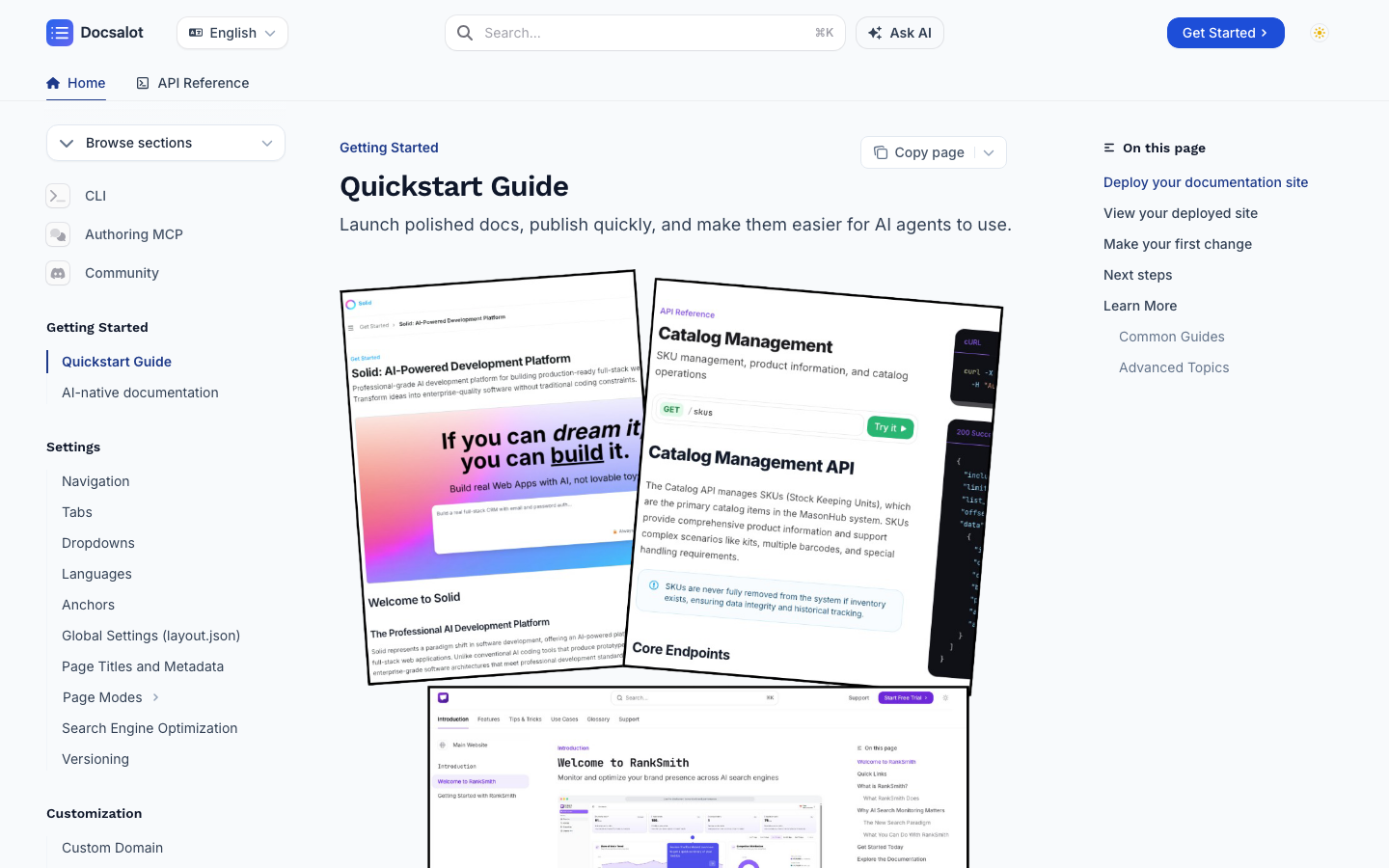
The screenshot shows a live DocsAlot documentation site. Use your current ClickHelp URL to create the more useful comparison: the same content, navigation, and routes rendered as a private DocsAlot draft.
Starting price
What it costs to get started.
Entry prices are in USD. Compare what is included, not just the number.
Startup includes one managed public docs site, search, a visual editor, and agent-readable docs. See plan details for custom domains and private docs.
Confirm the month-to-month Starter quote for your contributors and add-ons.
Workflow comparison
Compare what your team gets.
Swipe sideways on mobile to view the full matrix.
| Dimension | DocsAlot | ClickHelp | Takeaway |
|---|---|---|---|
| Documentation breadth | Strong | Strong | Both can cover broad documentation jobs. The real difference is operating model, not simple feature count. |
| Classic authoring-tool depth | Lighter | Stronger | ClickHelp if workflow modules, permissions, reporting, and traditional authoring controls are a priority. |
| Migration and import breadth | Good | Strong | ClickHelp if migration from a wide set of legacy documentation tools is a central requirement. |
| AI / agent readiness | llms.txt + skill.md + hosted MCP | AI Suite inside the portal | Both use AI, but DocsAlot is stronger if AI-readable distribution is an explicit goal. |
| Authoring overhead | Lower | Higher | DocsAlot if the team wants a lighter workflow than a fuller documentation platform requires. |
| Help-center and developer-docs mix | Stronger | Good | DocsAlot if the docs layer must feel more like a modern product surface than a classic documentation portal. |
This matrix is intentionally dense because these pages are meant to answer buying questions, not just act as thin keyword landing pages.
Long-form read
What this comparison means in practice.
Use this section to read the buying boundary in plain language before you over-index on the checklist.
Read this when the real question is not feature parity alone, but whether the organization still needs the weight and complexity of ClickHelp.
ClickHelp sits between modern hosted docs and traditional documentation tooling. It can cover multiple documentation jobs, but still carries more of a classic authoring orientation than a lighter automation-first stack. In practice, teams usually choose ClickHelp when You prefer a more traditional authoring workflow: The team wants a documentation platform centered on stronger editorial control, classic modules, and broader documentation-tool depth. A single all-in-one docs tool is enough: You do not need the lighter automation-first operating model as much as you need one broad documentation product with workflow, reporting, and migration depth.
DocsAlot is a better fit when the organization wants to move away from a heavier authoring toolchain and toward a calmer hosted workflow with lower maintenance overhead. That becomes the stronger fit when You want a lighter docs operating model: The team wants to publish faster with less authoring-tool process, fewer add-ons, and lower recurring overhead. AI-readable delivery matters: You want llms.txt, skill.md, and hosted MCP access in addition to the human-readable docs experience.
ClickHelp is a broader documentation tool with more traditional authoring expectations. DocsAlot is stronger when the team wants a lighter, more automation-friendly operating model. Use the matrix and FAQs to compare workflow and migration fit before you switch.
Migration path
Test a move from ClickHelp without risking search traffic.
Keep the current site live while you review a private DocsAlot draft. Switch only after the content, design, routes, and redirects have earned approval.
- Start with the live docs. Submit the current public URL so the first draft begins with real content and navigation instead of an empty workspace.
- Review a private preview. Check page structure, code examples, assets, search, responsive behavior, and the published design while the existing site remains untouched.
- Keep the source model that works. Connect the repository when Git should remain canonical, then use pull requests, coding agents, or the browser editor without rebuilding the publishing stack.
- Preserve URLs before DNS changes. Keep the existing domain and page paths wherever possible, then create one-to-one redirects for every route that must change.
- Cut over only after approval. Change the domain when the replacement is ready, submit the sitemap, and monitor indexing, clicks, redirects, and crawl errors after launch.
The evaluation is reversible: your current ClickHelp site stays live until the DocsAlot version is ready. Preserve the same domain and routes and search engines continue to resolve the same URLs; only the publishing layer changes.
Product shape
What each product is optimized to do.
Two tools can overlap on outputs while still being built for very different documentation jobs. This is the higher-level operating-model read.
ClickHelp
What ClickHelp optimizes for.
ClickHelp sits between modern hosted docs and traditional documentation tooling. It can cover multiple documentation jobs, but still carries more of a classic authoring orientation than a lighter automation-first stack.
DocsAlot
What DocsAlot optimizes for.
DocsAlot is a better fit when the organization wants to move away from a heavier authoring toolchain and toward a calmer hosted workflow with lower maintenance overhead.
FAQs
Questions that usually block the switch.
These are usually the questions that slow internal alignment, migration planning, or procurement once the shortlist is already real.
Will moving from ClickHelp affect our SEO or GEO?
It should not when the migration preserves the current domain, page paths, metadata, canonicals, and internal links. We map changed paths with redirects, validate the sitemap before launch, and keep the existing site live until the replacement is ready.
Can DocsAlot help us migrate from ClickHelp?
Yes. Start with the current public docs URL and DocsAlot can prepare a private migration draft. We review content, navigation, assets, URL mapping, and redirects before any production cutover.
Can Git remain the source of truth?
Yes. Keep documentation in the repository and use pull requests or coding agents as the primary workflow. DocsAlot adds the hosted preview and publishing layer rather than forcing the source into a proprietary editor.
Do we need to take the current docs offline to evaluate DocsAlot?
No. Build and review the DocsAlot version on a private preview URL while the current site remains untouched. Change the domain only after the content, routes, and design have been approved.
When should we stay with ClickHelp?
Stay with ClickHelp when structured authoring, complex reuse, localization governance, or legacy publishing outputs are non-negotiable and the installed process still earns its operational cost.
Is ClickHelp more than a legacy help-authoring tool?
Yes. ClickHelp is broader than that label suggests. It spans API docs, developer docs, manuals, tutorials, hosting, and migration services in one system.
When does ClickHelp still make more sense?
ClickHelp makes more sense when the team wants one broad documentation platform with stronger workflow modules, migration breadth, and classic authoring controls than a lighter docs stack typically offers.
Is DocsAlot always cheaper than ClickHelp?
At the public-plan level, yes. But the more important question is whether you need ClickHelp's broader authoring-tool depth badly enough to justify the higher starting price and add-ons.
Can ClickHelp handle multiple docs use cases?
Yes. It explicitly covers manuals, knowledge bases, tutorials, developer docs, and API docs. The honest comparison is about workflow style and operating complexity, not whether it can cover enough use cases.
What is the cleanest way to think about this comparison?
ClickHelp is a broad documentation tool with stronger classic authoring DNA. DocsAlot is a lighter documentation system aimed at faster rollout, lower upkeep, and stronger AI-readable delivery.
Customer proof
What teams say after publishing with DocsAlot.
These are DocsAlot customers and live documentation sites. They are product proof, not a claim that every customer migrated from ClickHelp.
"Fantastic stuff! The introduction perfectly nails the Mako Code's idea. I particularly enjoyed the Technical Deep Dive with its explained code snippets, and the Project Architecture's file tree was both cool and useful."
"I don't know what you did, but it's amazing. Just having our docs on DocsAlot gave us an uptick in SEO, the page-load speed is super fast, and auto-sync is a game changer."
"We were looking into Mintlify/GitBook for our docs, but were disappointed. Super expensive ($300) for the value they were offering. Switched to DocsAlot and couldn't be happier."
Try the workflow
Ready to test whether DocsAlot fits your documentation stack?
Use your current ClickHelp docs as the starting point. DocsAlot will carry the public URL into onboarding so you can generate and review an editable migration draft.